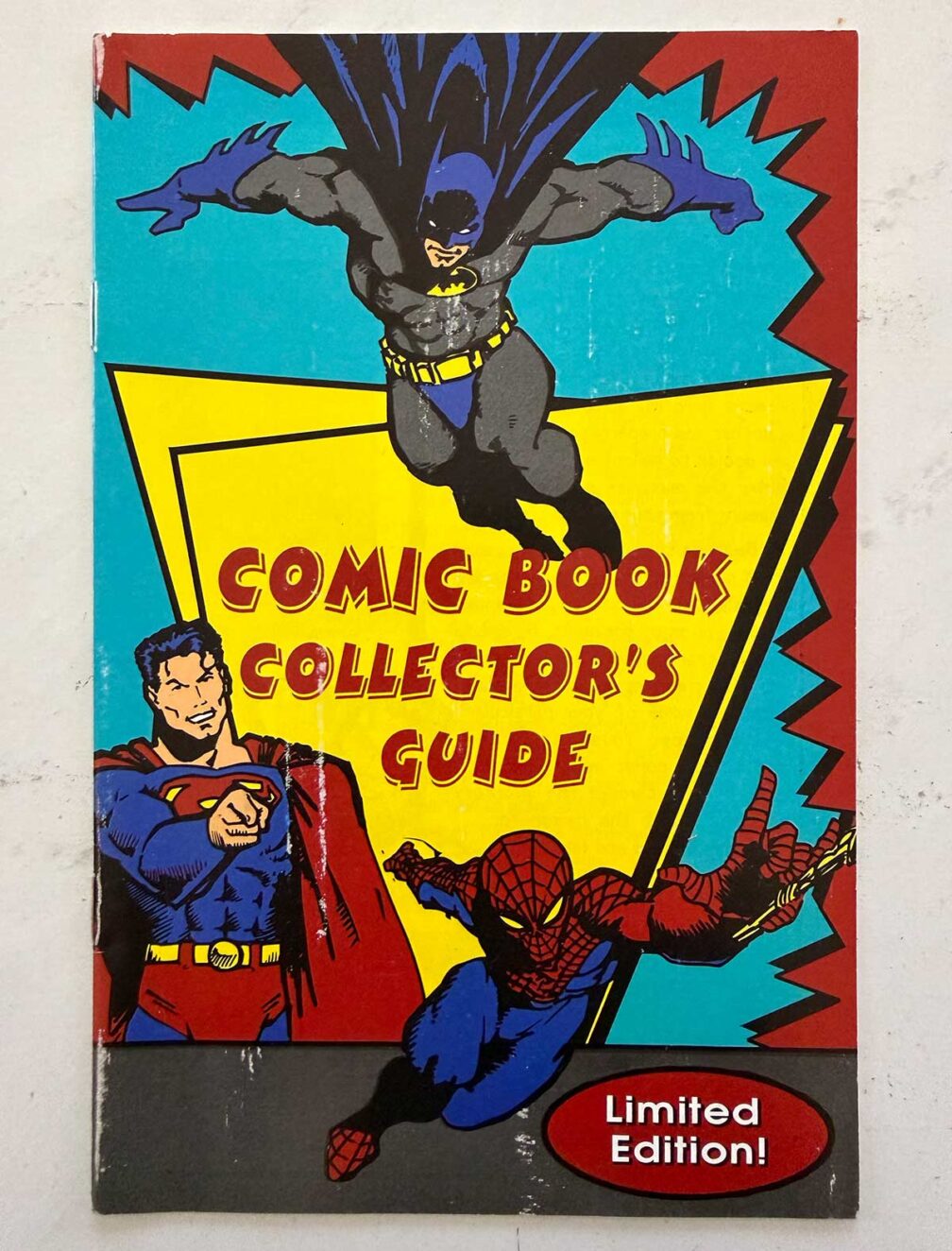
While digging through a large collection we recently acquired, we stumbled across this little gem: a vintage Comic Book Collector's Guide with no date, no publisher, and no explanation of how it came to exist. Just a Limited Edition badge on the cover and decades worth of genuinely good advice inside.
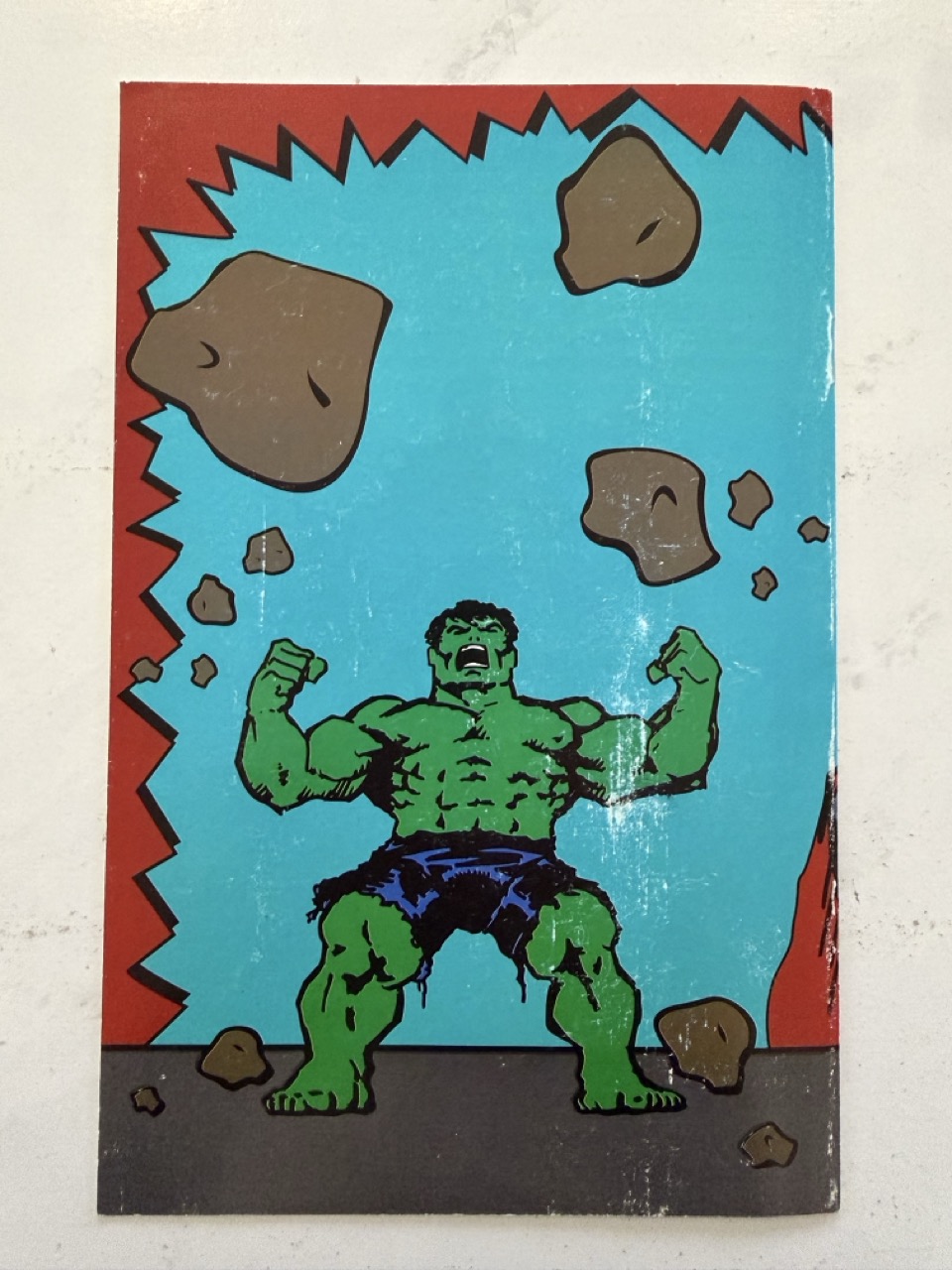
We have no idea when it was printed. Could be the late '80s. Could be early '90s. The Hulk on the back cover isn't talking, and neither is anyone else.
What we do know is that the advice inside holds up surprisingly well, and the whole thing is just too good to leave buried in a long box. So we've brought it back to life here, scans and all, for collectors old and new. Retro? Absolutely. Still useful? More than you'd think.
Welcome to a little piece of comic collecting history. Enjoy the read.
BEGINNING YOUR COLLECTION…
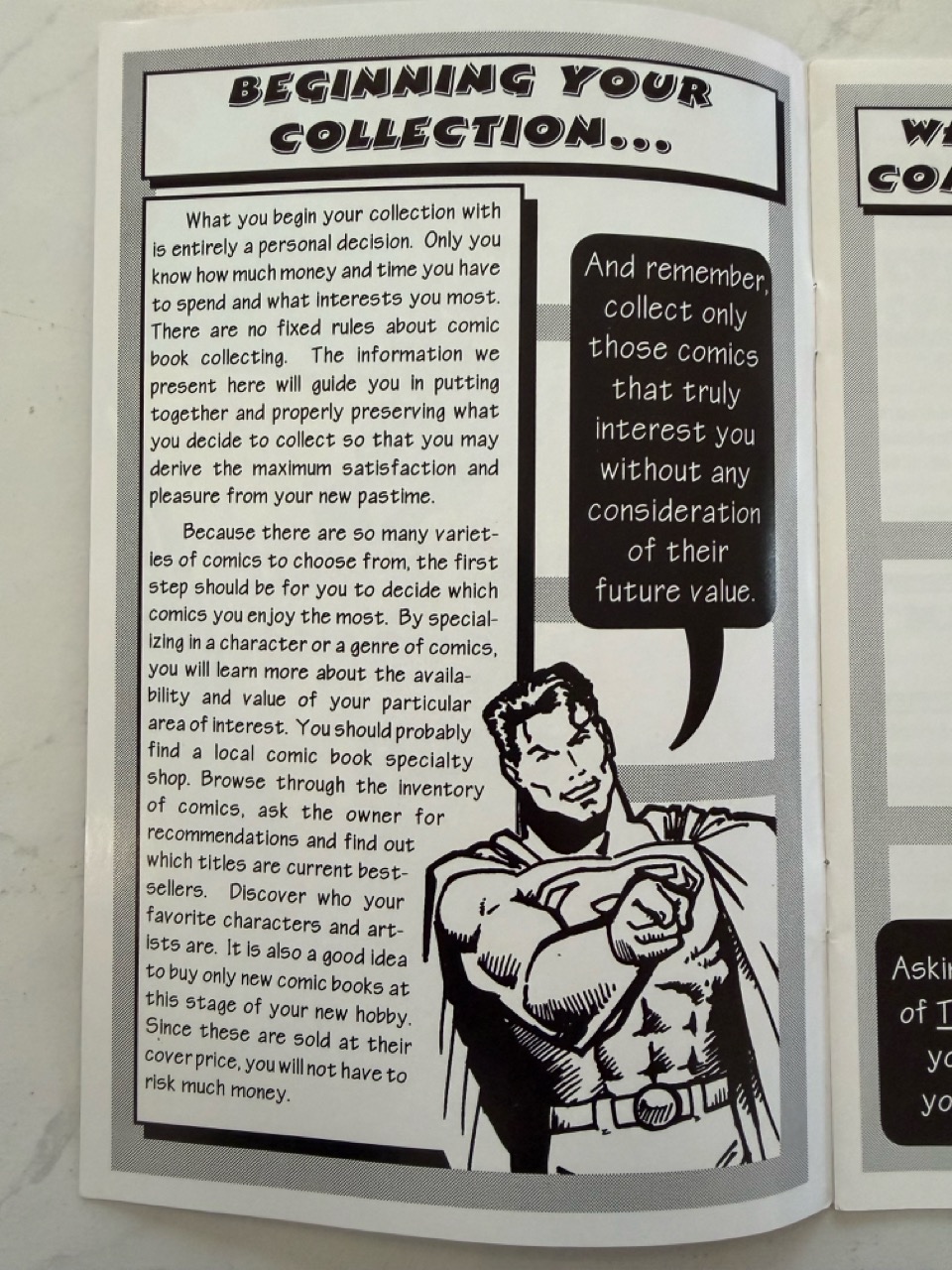 What you begin your collection with is entirely a personal decision. Only you know how much money and time you have to spend and what interests you most. There are no fixed rules about comic book collecting. The information we present here will guide you in putting together and properly preserving what you decide to collect so that you may derive the maximum satisfaction and pleasure from your new pastime.
Because there are so many varieties of comics to choose from, the first step should be for you to decide which comics you enjoy the most. By specializing in a character or a genre of comics, you will learn more about the availability and value of your particular area of interest. You should probably find a local comic book specialty shop. Browse through the inventory of comics, ask the owner for recommendations and find out which titles are current best-sellers. Discover who your favourite characters and artists are. It is also a good idea to buy only new comic books at this stage of your new hobby. Since these are sold at their cover price, you will not have to risk much money.
"And remember, collect only those comics that truly interest you without any consideration of their future value."
WHERE TO FIND THE COMICS YOU DESIRE…
 In the past, most comics could be bought at the local candy store for a dime. These days, such corner stores have become a rarity and comic books cost ten times as much. Most of today's collectors began by buying and saving their favourite current comic books and then graduated to specializing in and acquiring hard-to-find back issues and rare specimens. As you become more and more sophisticated, you will learn that the local comic book specialty shop is perhaps the most expensive way to build your collection. Very often, mail order ads in the comic collector's magazine offer extremely competitive prices for individual and bulk collections because of the reduced overhead and mass buying power.
The experienced collectors often employ a variety of sources to build and refine their growing collections such as antique shops, flea markets, bookstores and garage sales. One popular and growing source is the comic book conventions that take place around the country each year. You can find out about these events (as well as learn about what is available and at what price) from the monthly periodicals devoted to your comic book hobby.
"Asking your local dealer or consulting the pages of The Comic Buyer's Guide will greatly assist you in keeping track of what is happening in your particular field of comic book interest."
KINDS OF COMIC BOOKS…
 When you decide to begin specializing within your favourite area of interest, you have a broad spectrum from which to choose. Genre refers to the main theme or subject matter of a field of comic books. The selection includes horror, funny animals, jungle books (like Tarzan of the Apes), romance themes, science fiction, superheroes, war stories, westerns, and educational comics.
You might also decide to focus on particular publishers of comics such as Centaur, DC Comics, Dell Publishing, EC Comics, Fawcett Publications, Marvel Comics and others. In any case, as we have stressed all along, be sure to collect only those comics that appeal to you personally so any appreciation in value becomes an added plus rather than a requirement for your pleasure.
COMIC BOOKS AS AN INVESTMENT…
While there is no guarantee that comic books, or any other collectible for that matter, will provide a competitive return on the investment, comic book investors have experienced a relatively favourable trend in recent years for certain genres and specialties.
As a rule, comic book collectors think very little about the future value of their collections. They are often reluctant to part with their favourite books, even if they are offered substantial sums of money. If we have any advice to offer the profit-minded new collector, it would be to make your collection enduringly important to you even if the value of a particular comic should remain the same or even diminish in value. By specializing, however, you are more likely to become an expert in your field of interest. This expertise will help to ensure that you make the correct buying decisions and collecting judgements from a long-term investment point of view.
HOW TO CARE FOR YOUR VALUABLE COLLECTION…
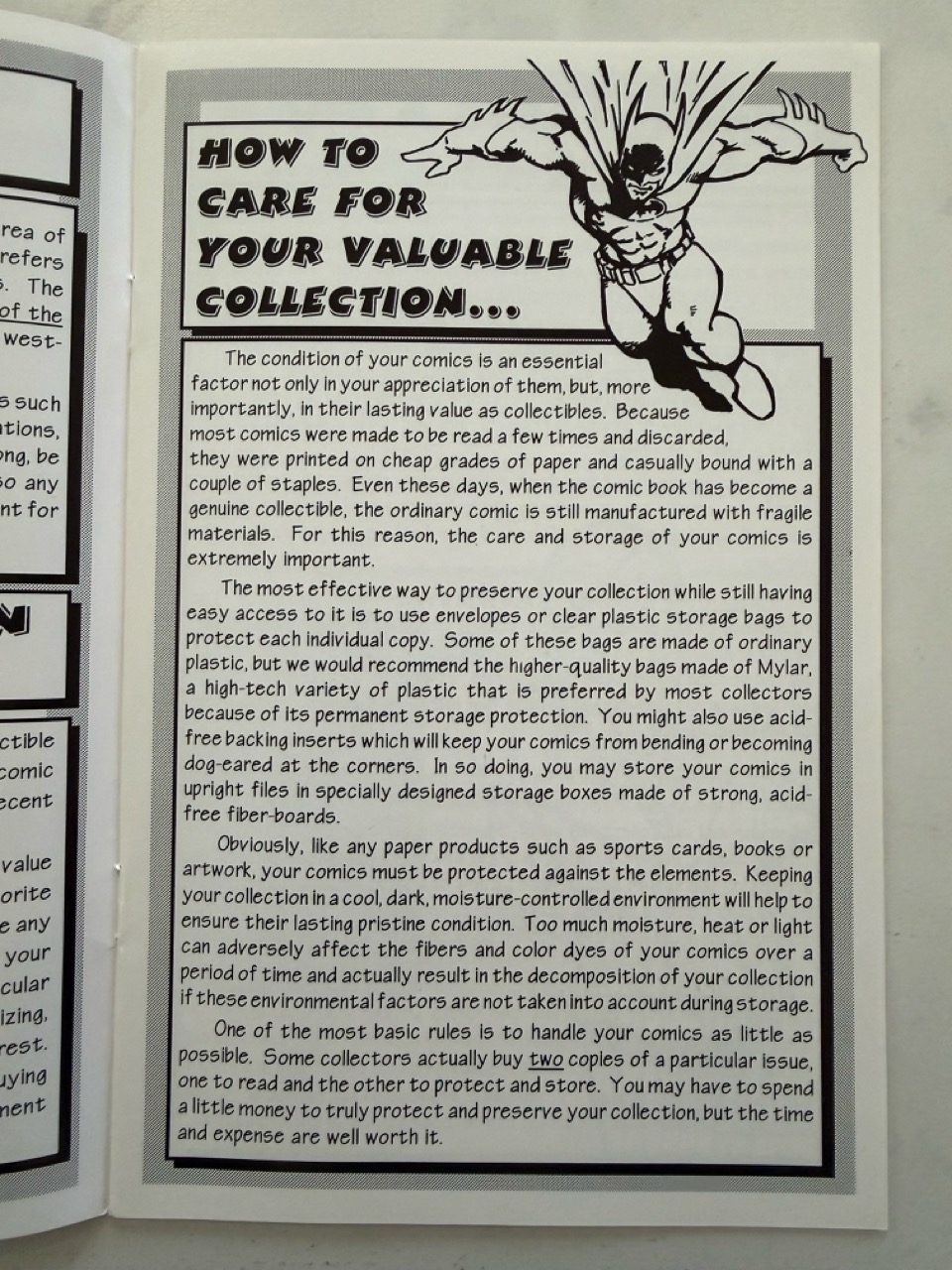 The condition of your comics is an essential factor not only in your appreciation of them, but, more importantly, in their lasting value as collectibles. Because most comics were made to be read a few times and discarded, they were printed on cheap grades of paper and casually bound with a couple of staples. Even these days, when the comic book has become a genuine collectible, the ordinary comic is still manufactured with fragile materials. For this reason, the care and storage of your comics is extremely important.
The most effective way to preserve your collection while still having easy access to it is to use envelopes or clear plastic storage bags to protect each individual copy. Some of these bags are made of ordinary plastic, but we would recommend the higher-quality bags made of Mylar, a high-tech variety of plastic that is preferred by most collectors because of its permanent storage protection. You might also use acid-free backing inserts which will keep your comics from bending or becoming dog-eared at the corners. In so doing, you may store your comics in upright files in specially designed storage boxes made of strong, acid-free fibre-boards.
Obviously, like any paper products such as sports cards, books or artwork, your comics must be protected against the elements. Keeping your collection in a cool, dark, moisture-controlled environment will help to ensure their lasting pristine condition. Too much moisture, heat or light can adversely affect the fibres and colour dyes of your comics over a period of time and actually result in the decomposition of your collection if these environmental factors are not taken into account during storage.
One of the most basic rules is to handle your comics as little as possible. Some collectors actually buy two copies of a particular issue, one to read and the other to protect and store. You may have to spend a little money to truly protect and preserve your collection, but the time and expense are well worth it.
"You may have to spend a little money to truly protect and preserve your collection, but the time and expense are well worth it."
WHAT MAKES A COMIC BOOK VALUABLE…
 Comic books obey the same laws of supply and demand that other commodities do. How many comic books were originally printed and how many are available today are obviously major factors. The popularity — or, in some cases, the unpopularity — is another important factor in determining the ultimate value of a given comic book or genre. Condition is another major factor, one which, for years, many collectors were not as attentive to as are today's more educated collectors. For this reason, comics in mint condition from the early "Silver" or "Golden" years of comics would not only be extremely rare, but would command a higher price in the marketplace.
There are no fixed and fast rules in determining the value of a particular comic, but a common denominator would have to be the demand for a given comic. Some of the factors that influence the demand are:
FIRST ISSUE: This has always been a value-enhancing factor. The first issue of any new series, especially if that series went on to become widely popular, is often worth three, four… even up to ten times as much as the second issue in the same series. Even recent first issues (such as Teenage Mutant Ninja Turtles) can bring significantly more money than subsequent issues in a series.
THE CHARACTERS: It is no secret that certain characters enjoy instant mass appeal and sometimes maintain this appeal for generations of young and old collectors alike (Superman, for example). Because of the intangible nature of the factors which create this phenomenon, predicting the future popularity of a new character is a virtual impossibility. It is for this reason that some collectors will automatically buy the first issue of every new comic book that appears on the market.
THE RARITY OF AN ISSUE: Depending upon the interest in a particular character or series, the rarity of the individual issue can greatly influence its value. Inasmuch as many copies of early comics were either discarded or ruined due to neglect, pristine copies of rare issues can be of enormous value. For instance, because of its rarity, an Action Comics #1 in near-mint condition has an asking price in the thousands.
THE ARTISTIC VALUE: Certain artists enjoy local followings that can greatly increase the value of any comics they drew. Frank Frazetta's work on Thun'da, the jungle adventure series from the 1950s, has made this particular comic a favourite of collectors and helped to enhance Frazetta's reputation as a celebrated artist in the comic book field. Bob Kane, Siegel and Shuster, Will Eisner and Jack Kirby are similarly popular comic book artists.
MILESTONES: Some comic books acquire an additional dimension and value because of the first appearance of a subsequently popular figure in that particular issue. A good example of this is Detective Comics #37, which was the issue where Robin, Batman's loyal sidekick, first appeared. Likewise, the very last appearance of a character can greatly enhance the value of a comic. Another feature that will inflate the value of an otherwise undistinguished issue is a phenomenon known as "crossover" or "cameo." This is when a character from another series makes a guest appearance in a comic for an entire story or a few short panels.
HOW TO GRADE YOUR OWN COLLECTION…
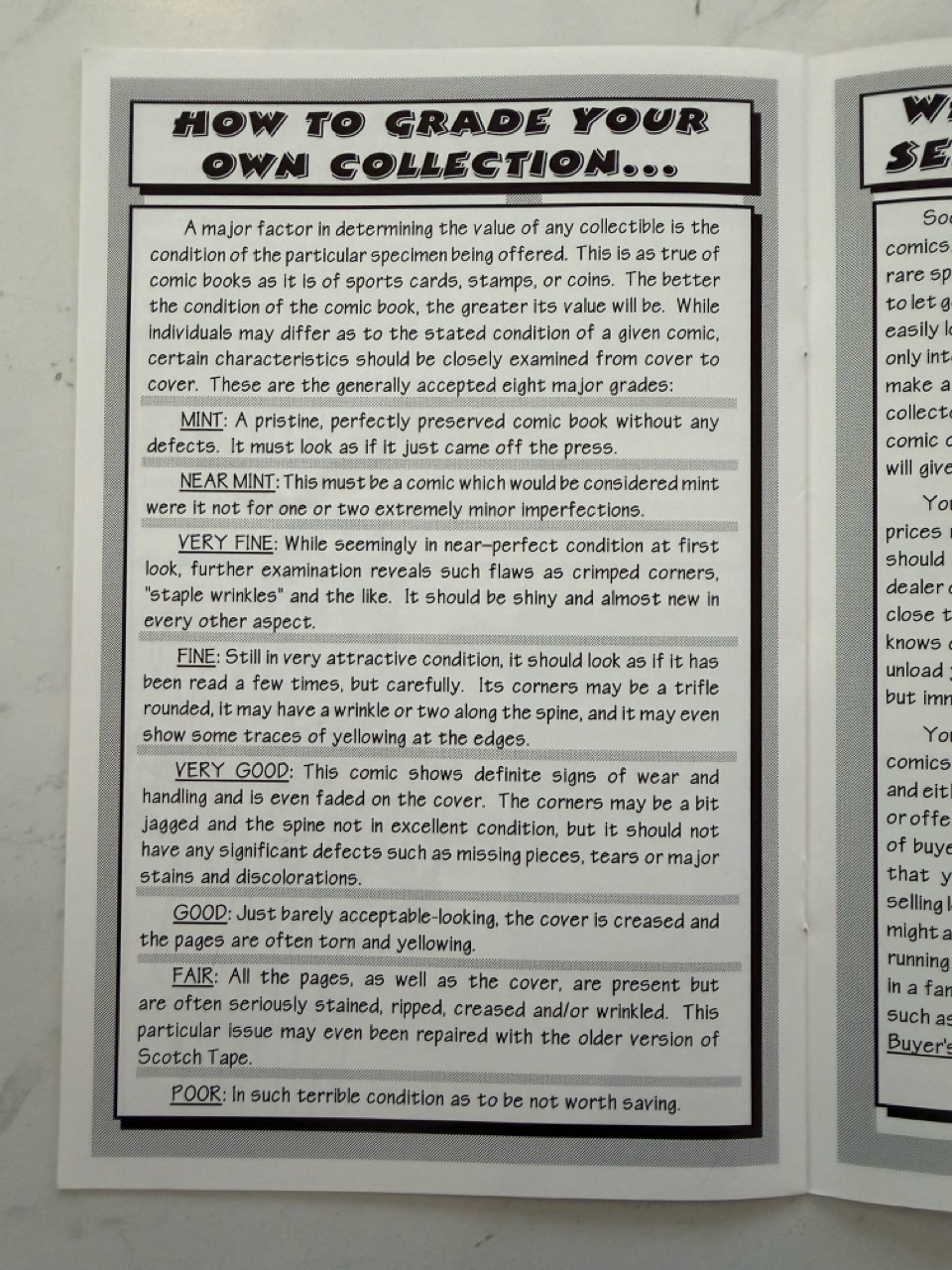 A major factor in determining the value of any collectible is the condition of the particular specimen being offered. This is as true of comic books as it is of sports cards, stamps, or coins. The better the condition of the comic book, the greater its value will be. While individuals may differ as to the stated condition of a given comic, certain characteristics should be closely examined from cover to cover. These are the generally accepted eight major grades:
MINT: A pristine, perfectly preserved comic book without any defects. It must look as if it just came off the press.
NEAR MINT: This must be a comic which would be considered mint were it not for one or two extremely minor imperfections.
VERY FINE: While seemingly in near-perfect condition at first look, further examination reveals such flaws as crimped corners, "staple wrinkles" and the like. It should be shiny and almost new in every other aspect.
FINE: Still in very attractive condition, it should look as if it has been read a few times, but carefully. Its corners may be a trifle rounded, it may have a wrinkle or two along the spine, and it may even show some traces of yellowing at the edges.
VERY GOOD: This comic shows definite signs of wear and handling and is even faded on the cover. The corners may be a bit jagged and the spine not in excellent condition, but it should not have any significant defects such as missing pieces, tears or major stains and discolourations.
GOOD: Just barely acceptable-looking, the cover is creased and the pages are often torn and yellowing.
FAIR: All the pages, as well as the cover, are present but are often seriously stained, ripped, creased and/or wrinkled. This particular issue may even have been repaired with the older version of Scotch Tape.
POOR: In such terrible condition as to be not worth saving.
A GLOSSARY OF SOME COMMONLY USED COMIC BOOK TERMS…
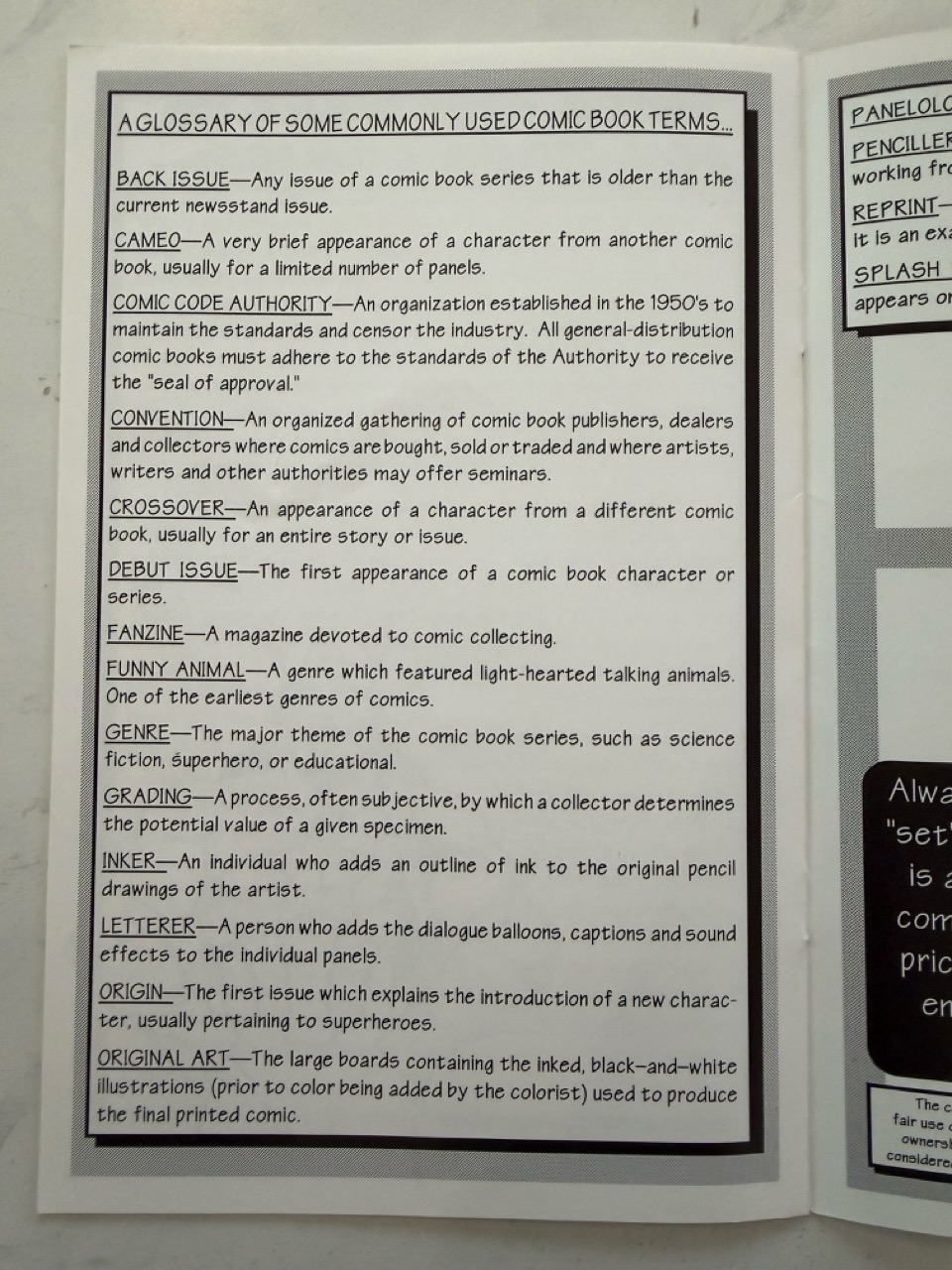 BACK ISSUE — Any issue of a comic book series that is older than the current newsstand issue.
CAMEO — A very brief appearance of a character from another comic book, usually for a limited number of panels.
COMIC CODE AUTHORITY — An organization established in the 1950s to maintain the standards and censor the industry. All general-distribution comic books must adhere to the standards of the Authority to receive the "seal of approval."
CONVENTION — An organized gathering of comic book publishers, dealers and collectors where comics are bought, sold or traded and where artists, writers and other authorities may offer seminars.
CROSSOVER — An appearance of a character from a different comic book, usually for an entire story or issue.
DEBUT ISSUE — The first appearance of a comic book character or series.
FANZINE — A magazine devoted to comic collecting.
FUNNY ANIMAL — A genre which featured light-hearted talking animals. One of the earliest genres of comics.
GENRE — The major theme of the comic book series, such as science fiction, superhero, or educational.
GRADING — A process, often subjective, by which a collector determines the potential value of a given specimen.
INKER — An individual who adds an outline of ink to the original pencil drawings of the artist.
LETTERER — A person who adds the dialogue balloons, captions and sound effects to the individual panels.
ORIGIN — The first issue which explains the introduction of a new character, usually pertaining to superheroes.
ORIGINAL ART — The large boards containing the inked, black-and-white illustrations (prior to colour being added by the colourist) used to produce the final printed comic.
PANELOLOGY — The study and collection of comic books.
PENCILLER — The artist who draws the original panels for the comic book, working from the writer's story or script.
REPRINT — A reproduced copy of a valued story or comic book. When it is an exact copy in every respect, it is a FACSIMILE.
SPLASH PANEL — The over-large panel or full-page illustration that appears on the opening page of each comic or comic book story.
"Always remember, there is no such thing as a 'set' or a 'fair' price for any comic. The value is as great or as poor as the appeal of the comic to the individual buyer or seller. If the price you are offered for your comics is not enough to exceed the pleasure you derive from owning, simply do not sell them."